What to Expect in Your First Month Working with an Offshore Dev Team
A week-by-week breakdown of what actually happens when you start working with a dedicated offshore development team, from Day 1 setup to full-speed sprints by Day 30.
You signed the contract. The team is assigned. Slack channels are created. Now what?
Most founders I talk to have a clear picture of what they want built, but almost no picture of what the first 30 days with an offshore dev team actually look like. And that gap between expectation and reality is where most working relationships start to crack.
So here's what actually happens, week by week, when you start working with a dedicated offshore team. No sugarcoating.
Week 1: almost nothing ships (and that's fine)
Your new developers will spend most of their first week reading your codebase, setting up their local environments, and asking questions. A lot of questions. If they're not asking questions, that's actually the red flag.
Expect maybe two or three small pull requests. Bug fixes, minor UI tweaks, a documentation update, maybe a config cleanup. Nothing meaningful in terms of features. Their real output this week is context. They're learning how your app is structured, what your naming conventions look like, where the weird legacy code lives.
Your job in Week 1 is access. Every hour a developer spends waiting for credentials, VPN setup, or repo permissions is an hour wasted. Get all of that sorted before Day 1. Not on Day 1.
According to research from Full Scale, teams that skip this prep work lose 6 to 12 weeks of productivity. Not days. Weeks.
Budget about 2 hours per day from someone on your side acting as a buddy. That person answers questions, reviews the first PRs, explains why that one service is structured weirdly, and points the new developers toward the right Slack channels when they get stuck.
Week 2: the real test starts
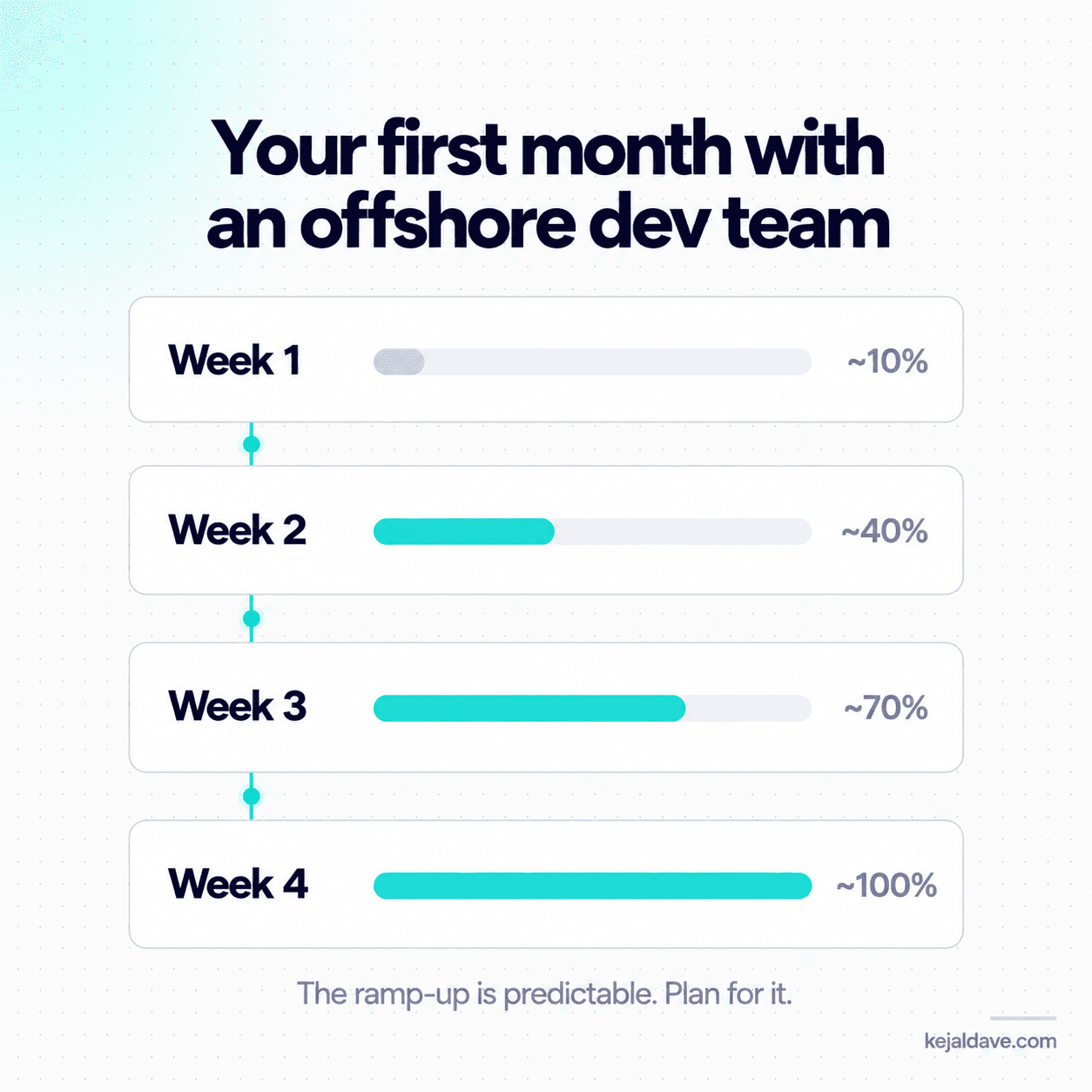
By the second week, your offshore developers should be completing 5 to 8 pull requests and finishing 2 to 3 user stories independently. They're at roughly 40% of full productivity, which sounds low but is exactly on track.
This is also when problems surface. If a developer is still silent in standups, still not asking questions, or submitting code that misses your patterns entirely, that's a signal. It doesn't always mean they're the wrong hire. Sometimes it means the onboarding materials are outdated (and honestly, if your internal docs haven't been updated in six months, they probably are). But it does mean you need to adjust something now, not in Week 4.
The communication rhythm should be settling in by this point. Daily standups, async Slack updates at end of day, and at least one pairing session per developer. If you're in a very different timezone (say, Australia or the US working with a team in South Asia), the pairing sessions matter even more because they compress what would otherwise take a full day of back-and-forth messages into 45 minutes.
Week 3: momentum builds
Week 3 is where it starts feeling real. Developers are handling multi-day tasks, pairing sessions drop from daily to two or three per week, and you're seeing code that actually fits your codebase style without constant correction.
Productivity is around 70%. Your developers should be participating in sprint planning, joining retros, and flagging blockers before you have to ask about them.
If you're still micromanaging at this point, something went wrong in Weeks 1 or 2. Either the developers aren't the right fit, or your onboarding didn't give them enough context to work independently. Both are fixable, but you need to figure out which one it is.
Week 4: full speed
By Day 30, a well-onboarded offshore developer should be hitting 6 to 8 story points per sprint, which is comparable to what you'd expect from a mid-level developer who's been on your team for months. The benchmarks Full Scale tracks show 15 to 25 PRs merged and 8 to 12 stories completed by the end of Month 1.
This is also when you should run a formal 30-day review. Not a performance review in the HR sense. More of a checkpoint: what's working, what's not, what tools or access would make things faster. The developers who stick around for years are usually the ones who felt heard in that first review.
The mistakes that cost you the most time
I see the same patterns over and over with founders who've never managed an offshore team before.
Giving complex features on Day 1. Your new developer doesn't know your codebase yet. A two-day task for your existing team is a two-week task for someone who's still figuring out where the API routes live.
Judging output at Day 7. Week 1 is orientation, not production. If you're disappointed by the lack of shipped features in the first five days, your expectations are mis-calibrated, not your team.
Skipping the buddy system. Gallup's research shows 88% of employees with poor onboarding consider leaving within their first year. An offshore developer who feels lost and unsupported in Week 1 will either disengage or leave. Both cost you money. Full Scale estimates $15,000 to $25,000 in wasted salary from poor onboarding alone.
Treating offshore developers as separate from the team. Include them in retros, design reviews, architecture discussions, even the informal Slack channels. From Day 1. Not from Month 2 when they've "proven themselves." They can't prove anything if they don't understand the full picture.
What good looks like at Day 30
Your offshore team is shipping at the same velocity as your in-house developers. Standups run without awkward silences. PRs get reviewed and merged within hours, not days. You're not thinking about the fact that half your engineering team is in a different country, because the work just flows.
That's the goal. And it's completely achievable if you invest the 40 or so hours of your existing team's time in the first month to set things up properly.
If you're evaluating whether to bring on a dedicated offshore team, or you've just started and Week 1 feels chaotic, I'm happy to walk you through what a structured onboarding looks like for your specific stack and team size. You can reach me at kejaldave.com.
You're reading
What to Expect in Your First Month Working with an Offshore Dev Team
Oct 27, 2026 · 6 min read
More from the blog
- How to write a project brief that actually gets you accurate quotesOct 20, 2026
- How to Manage a Dedicated Offshore Dev Team (Without Micromanaging Every Sprint)Oct 13, 2026
- What It Actually Costs to Build an MVP in 2026Oct 6, 2026
- How to Vet a Dev Team Before You SignSep 29, 2026
- What UAE Founders Get Right About Outsourcing That Most Markets Don'tSep 23, 2026
- Why Your First Hire After Raising a Round Shouldn't Be a Developer?Sep 13, 2026