How to Manage a Dedicated Offshore Dev Team (Without Micromanaging Every Sprint)
You signed the contract, the team is onboarded, and now you're checking Slack every 20 minutes wondering if anyone is actually working. Here's how to manage an offshore dev team without becoming the bottleneck yourself.
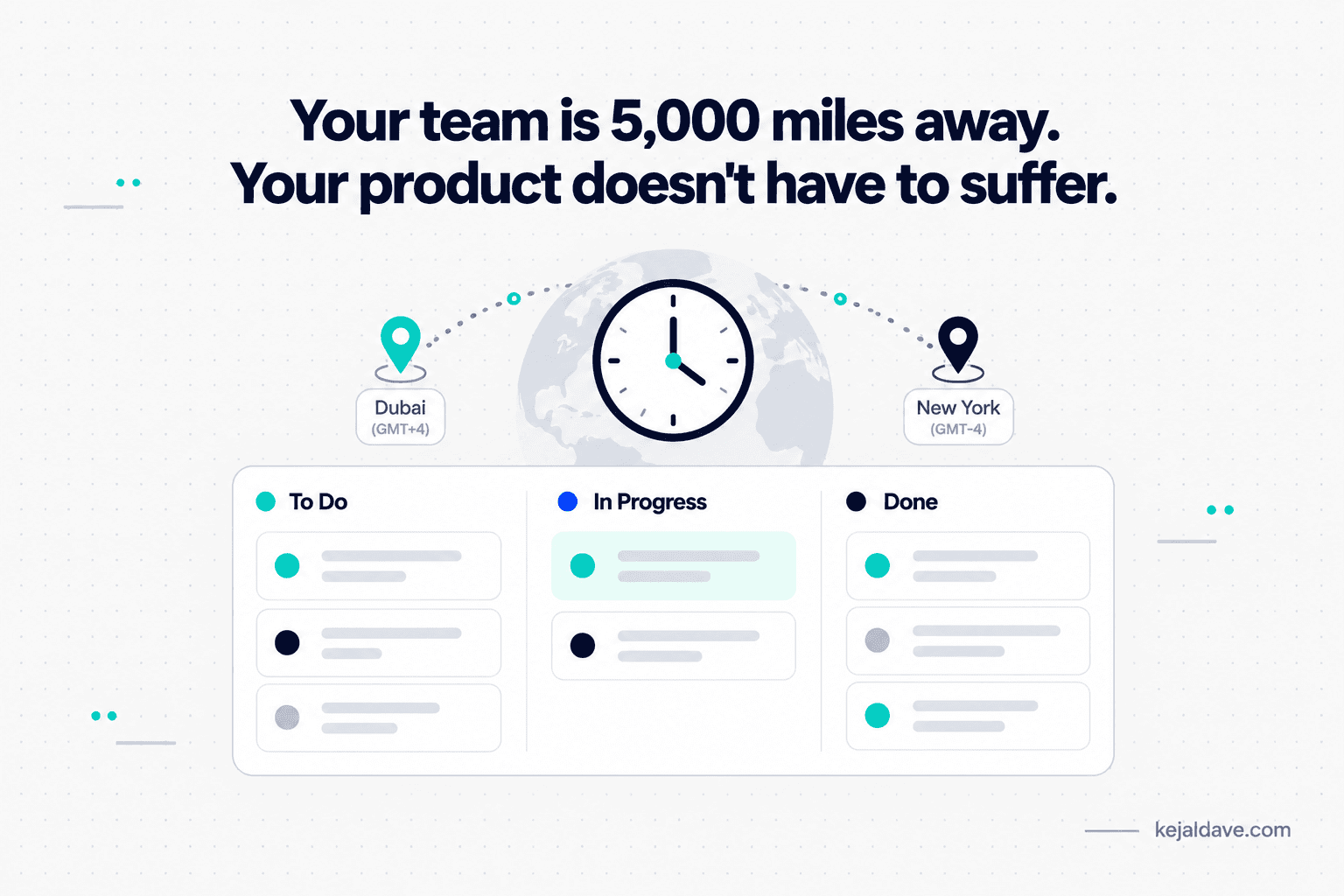
How to manage a dedicated offshore dev team (without micromanaging every sprint)
You signed the contract. The team passed your vetting process. The first sprint kicks off Monday.
And by Wednesday, you're refreshing Slack every 15 minutes, wondering why nobody has pushed a commit since lunch. By Friday, you've written a 400-word message asking for a "quick status update" that takes the lead developer 45 minutes to answer properly.
I've watched this pattern play out with founders in Dubai, London, Sydney, and Toronto. The team is competent. The founder is invested. But the management layer between them is either too loose or way too tight, and the project suffers either way.
Here's the operating rhythm I set up for the founders I work with when they're running a dedicated offshore team for the first time.
Your first decision: who owns the daily?
Every offshore engagement needs exactly one person on the client side who talks to the development team daily. Not the CEO popping into standups when they feel like it. Not three stakeholders sending conflicting priorities into a shared Slack channel. One person.
For founders who have a technical cofounder or a fractional CTO, this is straightforward. That person runs the daily standup, reviews pull requests, and approves sprint priorities.
For non-technical founders, you have two options. Hire a fractional CTO or technical PM at 10 to 15 hours per week ($2,000 to $4,500/month depending on geography and seniority). Or, if your offshore partner provides a delivery lead, use them as your proxy and stay at the weekly level only.
The worst setup I've seen: a non-technical founder attending every daily standup, asking questions about implementation details they don't understand, and making the team explain architectural decisions in plain English every morning. The standups went from 15 minutes to 45. The team started dreading them. Velocity dropped 30% in three weeks because half the morning was spent explaining instead of building.
The communication stack that actually works
I've tested dozens of combinations across client engagements. This is the one that sticks.
Slack (or Teams) for async daily communication. One channel per project, not per person. Pin the current sprint board link. Pin the staging environment URL. Pin the deployment checklist. The team should be able to find everything they need without asking anyone.
A 15-minute daily standup on video. Not 30 minutes. Not "however long it takes." Fifteen minutes, hard stop. Three questions per developer: what shipped yesterday, what's shipping today, what's blocking progress. If something needs a longer discussion, it gets its own follow-up call with only the people involved.
A weekly demo call with the founder or product owner. This is where the non-technical founder belongs. The team shows what they built that week on the staging environment. The founder gives feedback on the product, not the code. "This flow feels slow" is good feedback. "Why did you use Redux instead of Context?" is not your job unless you're also the technical lead.
A sprint planning session every two weeks. This one takes 60 to 90 minutes, and it's the most important meeting in the cycle. The team reviews what shipped, what slipped, and why. The product owner sets priorities for the next two weeks. Everyone leaves knowing exactly what "done" looks like for every ticket.
Email for nothing. I'm serious. The moment project communication moves to email, response times triple and context gets lost in forwarded chains. Keep email for contracts and invoices. Everything else goes through your project channel.
Time zone overlap: the make-or-break window
If your team sits in India and you're based in Dubai, you have a comfortable 1.5 to 2.5-hour natural overlap, depending on the season. London to India gives you roughly 3 to 4.5 hours. Sydney to India is trickier because the overlap falls either early morning for one side or late evening for the other.
Here's the rule I give every founder: you need a minimum of two hours of real-time overlap per working day. Not "available on Slack if something comes up." Two hours where both sides are actively working, can jump on a quick call, and can unblock each other in real time.
Structure those two hours deliberately. Put your standup at the start of the overlap window. Use the remaining time for code reviews, design feedback, and quick unblocking conversations. Everything outside that window should be async, with clear enough context that the other side can pick it up without waiting for you.
The teams I broker for founders in Australia usually adopt a split-shift model: the offshore team starts their day at their normal time (9 or 10 AM IST), works through their core hours, and the overlap window falls at the end of their day/start of the Australian morning. The Australian founder does their standup at 8 or 9 AM AEST, gives feedback during the overlap, and the offshore team incorporates it the next morning.
This only works if every handoff includes context. "I'll fix it tomorrow" with no written notes means the developer spends the first hour of their next day trying to remember what "it" was. Every end-of-day handoff should include: what's done, what's in progress, what's blocked, and what decisions need the client side.
The oversight layer that catches problems early
Trust but verify. Give your team autonomy inside the sprint, but build three checkpoints into your process that catch drift before it becomes expensive.
Code reviews on every pull request. If you have a technical lead, they review everything before it merges. If not, your delivery lead should review, and you should get a weekly summary of what was merged and what was flagged. You don't need to understand the code. You need someone who does and checks it every day.
Deploy to staging at least twice per week. A staging environment is a copy of your app that runs with real-ish data but isn't live to customers. If your team only deploys to staging at the end of the sprint, you're waiting two weeks to see problems. Twice-weekly staging pushes mean you catch issues on Tuesday instead of discovering them at the Friday demo.
Sprint velocity tracking. This doesn't need fancy tools. A simple spreadsheet works. Track how many story points (or tasks, or tickets) the team commits to each sprint versus how many they actually complete. If the ratio drops below 70% for two consecutive sprints, something is wrong. Either the estimates are bad, the scope changes mid-sprint, or the team loses capacity to unplanned work. The numbers tell you which conversation to have.
What to do when things go sideways
They will. Every offshore engagement hits a rough patch. What separates a recoverable situation from a project failure is how fast you notice and how you respond.
A developer leaves the team. This happens. Attrition in Indian IT runs 15-25% annually. Your contract should include a notice period and a replacement commitment (typically 2 to 4 weeks for a same-level replacement). The real protection is documentation. If your codebase is well-documented and your processes are written down, a new developer can get productive in two weeks. If everything lives in one person's head, losing them sets you back two months.
The team misses a sprint target. Once is normal. Twice in a row needs a conversation. Look at the root cause before blaming the team. Did the scope change mid-sprint? Did a stakeholder add "just one more thing" without adjusting the timeline? Did a third-party API break something nobody could predict? In my experience, 60% of missed sprints trace back to unclear requirements or client-side scope changes, not developer underperformance.
Quality drops noticeably. If bugs start piling up or the staging environment breaks with every deployment, check two things first: is the team rushing because they're under pressure to hit an unrealistic deadline? And is QA coverage adequate, or is the team self-testing their own work? Developers testing their own code is like proofreading your own essay. You'll miss things. A dedicated QA person, even part-time, catches issues developers miss.
Communication goes quiet. If your normally responsive team suddenly takes 24 hours to reply, something changed. It's usually one of three things: they're stuck on a hard problem and don't want to admit it, they got pulled onto another client's emergency (if they're shared resources despite promising dedication), or there's an internal issue at the agency. Address it directly. "I noticed response times have slowed this week. What's going on?" works better than waiting to see if it resolves itself. It won't.
The tools I actually recommend
I get asked this constantly, so here's the short list.
For project management: Linear or Jira. Linear if you want something clean and fast. Jira if you need heavy customization and reporting. Trello works for very early-stage products with small teams, but you'll outgrow it quickly.
For code hosting: GitHub. Period. GitLab is fine too, but GitHub has the largest integration ecosystem, and every developer knows it.
For communication: Slack with a single project channel. Set expectations that messages during overlap hours get a response within 30 minutes. Outside overlap, next business day.
For design handoff: Figma. Your designer works in Figma, your developers pull specs and assets directly from it, and your founder can leave comments on screens without needing any technical knowledge.
For staging and deployments: Vercel for frontend, Railway or Render for backend, Supabase or PlanetScale for databases. All of these have free tiers that work fine for MVP and early-stage products. You can migrate to AWS or GCP later when you need to.
The management rhythm, summarized
Your week should look like this:
Monday through Friday: 15-minute daily standup during the overlap window. The technical lead or delivery lead runs it. You attend only if you're the technical lead.
Tuesday and Thursday: Staging deployments. You or your product person spend 20 minutes clicking through the new work on staging.
Friday: Weekly demo call, 30 minutes. The team shows what shipped. You give product feedback. You do not give code feedback unless you're qualified to.
Every other Monday: Sprint planning. 60 to 90 minutes. Priorities set, tickets assigned, "done" defined for every item.
Total time investment for a non-technical founder: 3 to 5 hours per week. That's it. If you're spending more than that managing your offshore team, your oversight structure is broken, and you're doing work that should belong to your delivery lead or technical PM.
The real cost of bad management
I want to be direct about this. The team model I broker for founders, dedicated offshore teams of 2 to 5 people, is the right economic choice for 80% of early-stage startups. But the model only works if you manage it properly.
A well-managed offshore team at $15,000 to $20,000/month will outperform a poorly managed one costing the same by 2x to 3x. The difference isn't the developers. It's the communication structure, the handoff discipline, and the oversight rhythm around them.
The founders I work with who get the best results treat their offshore team as an extension of their company, not a vendor they monitor. They invite them to product brainstorms. They share customer feedback directly. They celebrate shipped features. The team performs better because they understand what they're building and why it matters.
If you're running a dedicated offshore team right now and your velocity isn't where you expected, the bottleneck is probably not your developers. It's probably the layer between you and them.
Book a call, and I'll help you audit your current setup. No pitch, just a practical look at where the friction sits and what to fix first.
Sources:
- Management frameworks based on 10+ years of IT business development across offshore teams in India, Eastern Europe, and Southeast Asia
- Attrition data from TeamLease and NASSCOM India IT workforce reports (2025-2026)
- Tool recommendations based on usage patterns across 50+ client engagements
You're reading
How to Manage a Dedicated Offshore Dev Team (Without Micromanaging Every Sprint)
Oct 13, 2026 · 10 min read
More from the blog
- How to write a project brief that actually gets you accurate quotesOct 20, 2026
- What It Actually Costs to Build an MVP in 2026Oct 6, 2026
- How to Vet a Dev Team Before You SignSep 29, 2026
- What UAE Founders Get Right About Outsourcing That Most Markets Don'tSep 23, 2026
- Why Your First Hire After Raising a Round Shouldn't Be a Developer?Sep 13, 2026